
- Event
- Trade Unions
Launching "The Case for a Wealth Tax in Tanzania" at the Policy Dialogue on Tax Incentives
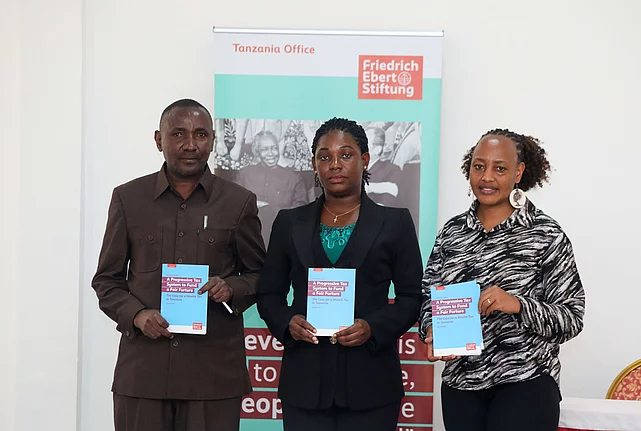
As part of the ongoing policy dialogue on tax justice and fiscal reforms in Tanzania, stakeholders gathered in Dodoma for a two-day engagement, bringing together labour leaders, policymakers, tax experts, and civil society actors to discuss the future of taxation and public financing in the country.
A key highlight of the event was the launch and dissemination of the publication “A Progressive Tax System to Fund a Fair Future: The Case for a Wealth Tax in Tanzania” by Balozi Morwa Mollel. The two-day workshop, held in Dodoma from 21st to 22nd May 2026, addressed key questions surrounding tax incentives, including the political economy and ideology shaping African tax systems, who benefits from corporate tax incentives, and the role of labor unions.
As Tanzania continues to experience economic growth, questions about who benefits from that growth are becoming increasingly important. The publication “The Case for a Wealth Tax in Tanzania” argues that while the country has produced significant wealth over the past decades, poverty and inequality remain widespread, with much of the tax burden falling on ordinary citizens rather than the wealthy.
“There is a clear need for more democratic, inclusive and equitable tax systems nationally and globally,” noted Mr. Christian Denzin, the FES Tanzania Resident Director, in his opening speech, a point echoed by Mr. Daniel Oberko, Regional Secretary for Africa & Arab Countries at Public Services International (PSI). “We have a responsibility to advocate and ensure that the avenues through which revenues are lost are sealed and that revenues finance quality public services,” said Mr. Oberko to the 4 trade unions that were part of the two-day workshop.

Trade unions expressed concern over the government’s continued granting of income tax exemptions in the absence of a strong framework capable of ensuring the realization of national development ambitions. In response to these concerns, a policy paper was developed to inform and guide the adoption of a comprehensive tax incentives framework for Tanzania aimed at improving transparency, accountability, and the effective administration of tax incentives. The proposed framework recommends, among other measures, that every tax incentive granted should guarantee technology and knowledge transfer; that tax incentives should not exceed a period of five years; and that the institutional framework governing the award of tax exemptions should be harmonized. The framework also emphasizes the need for a comprehensive cost-benefit analysis to be conducted before granting any company a tax incentive in order to assess the socio-economic implications of the investment.
Dr. Balozi’s publication, therefore, calls for a more progressive tax system that ensures those with greater wealth contribute a fairer share to national development. Recommendations include introducing wealth and inheritance taxes, reforming property taxation based on market value, reducing unnecessary tax exemptions, strengthening oversight of multinational corporations, and expanding taxation to better capture the digital economy and capital gains.
The launch complemented the wider discussions of the event, which focused on tax incentives, revenue justice, public services, and the need for progressive taxation systems that support inclusive development. The publication calls for stronger wealth and property taxation, improved tax administration, and closing loopholes that contribute to revenue losses and inequality.
Positioned within the broader conversation on fiscal justice, the launch provided an opportunity for participants to reflect on how Tanzania can mobilize domestic resources more fairly while ensuring sustainable funding for essential public services such as healthcare, education, and social protection.
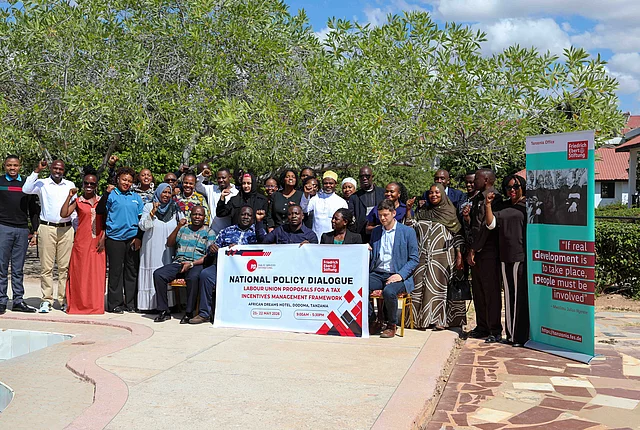
The event was organized through the collaboration of Friedrich-Ebert-Stiftung Tanzania and Public Services International (PSI), alongside labour movement partners and policy stakeholders in Tanzania, including the Researchers Academician & Allied Workers Union (RAAWU); Tanzania Union of Industrial and Commercial Workers (TUICO), Tanzania Local Government Workers Union (TALGWU), Tanzania Union of Government and Health Employees (TUGHE), who are all under the Trade Union Congress of Tanzania (TUCTA), a member of the PSI.

A progressive tax system to fund a fair future
Morwa, Balozi | Dar es Salaam : Friedrich-Ebert-Stiftung Tanzania, December 2025
the case for a wealth tax in Tanzania